
Juggling multiple productivity apps with endless features often creates more stress than solutions. You need a streamlined approach to daily organization that actually works. A well-designed daily routine checklist cuts through the noise, reduces decision fatigue, and helps you focus on what truly matters. This guide delivers research-backed strategies to build and optimize a high-performance checklist tailored to your energy, goals, and mental capacity in 2026.
Table of Contents
- How To Choose Criteria For Your Daily Routine Checklist
- Top Elements To Include In Your Daily Routine Checklist
- Comparing Popular Daily Routine Checklist Types And Tools
- How To Decide The Best Daily Routine Checklist For Your Goals And Lifestyle
- Boost Your Daily Routine With FloHub's Productivity Platform
- What Is A Daily Routine Checklist And Why Use One?
- How Does Habit Stacking Improve My Daily Routine?
- What Are The Pitfalls Of Relying Too Much On Digital Productivity Apps?
- How Often Should I Update My Daily Routine Checklist?
- Can A Simple Checklist Really Improve Productivity Significantly?
Key takeaways
| Point | Details |
|---|---|
| Checklists boost productivity | Structured daily checklists reduce decision fatigue and increase productivity by 10-30%. |
| Habit stacking works | Linking new habits to existing ones raises success rates up to 91%. |
| Manage three currencies | Time, energy, and focus are essential resources for sustainable high performance. |
| Simplicity prevents burnout | Overloaded productivity apps create frustration and decreased usage. |
| Morning routines matter | Early routines improve self-regulation and cognitive function. |
How to choose criteria for your daily routine checklist
Building an effective daily routine checklist starts with understanding what makes one work for you specifically. A high-performance daily routine is custom-built to match your goals, energy patterns, and mental capacity, not copied from someone else's Instagram post. Your morning energy might peak at 6 AM while your colleague hits their stride at 10 AM. Honor your natural rhythms instead of forcing yourself into a generic mold.
Simplicity beats complexity every time. Overcomplicating productivity apps leads to user frustration and decreased usage, which is why many people abandon sophisticated tools within weeks. Your checklist should feel like a helpful guide, not another obligation. Start with three to five core tasks and expand only when those become automatic.
Habit stacking transforms your routine from a willpower battle into an automatic sequence. This technique increases habit adherence by up to 91% because it links new behaviors to existing ones your brain already recognizes. After you pour your morning coffee, review your top three priorities. After you close your laptop, write tomorrow's task list. These connections create mental shortcuts that make productivity effortless.
Focus on systems rather than willpower. Systems reduce friction and multiply your output without draining mental energy. When you organize your life your way using habit tracking tools, you build sustainable routines that adapt to changing circumstances. Rigid routines crack under pressure, but flexible systems bend and grow with you.
Key criteria for your checklist include:
- Alignment with your chronotype and natural energy peaks
- Minimal complexity to reduce cognitive load
- Built-in flexibility for unexpected events
- Clear connection between daily tasks and long-term goals
- Regular review cycles to ensure continued relevance
Pro Tip: Test your checklist for two weeks before making major changes. This gives you enough data to spot patterns without committing to something that doesn't serve you.
Top elements to include in your daily routine checklist
Your checklist needs specific components backed by behavioral science to maximize productivity and well-being. Start each morning by writing down your top three priorities, which boosts productivity by over 30%. This simple act clarifies your focus before distractions flood in. Your brain performs best when it knows exactly what matters most.

Morning light exposure strengthens your circadian rhythm and sharpens mental performance throughout the day. Get outside within 30 minutes of waking, or use a bright light therapy lamp if natural sunlight isn't accessible. This biological signal tells your body it's time for peak cognitive function. Pair this with a cognitive warm-up like five minutes of focused reading or a brief planning session to activate your working memory.
End your day intentionally to protect sleep quality. Blue-light blocking glasses worn 90 minutes before bed improve sleep quality by 20%, which directly impacts next-day performance. Your evening routine should signal to your brain that work mode is over. This transition prevents the mental churning that keeps you awake at 2 AM.
Morning routines improve self-regulation and reduce decision fatigue, giving you more mental bandwidth for important choices later. Include these proven elements in your daily checklist:
- Priority identification session each morning
- Physical movement to boost energy and focus
- Dedicated time blocks for deep work without interruptions
- Midday energy assessment to adjust afternoon tasks
- Evening reflection to capture wins and lessons
Explore FloHub features to see how integrated tools support these elements without adding complexity. The platform's calmer productivity system emphasizes sustainable habits over hustle culture burnout.
Pro Tip: Stack your new habits onto existing anchors. After you brush your teeth, do two minutes of stretching. After you eat lunch, take a five-minute walk. These connections make new behaviors stick faster.
Comparing popular daily routine checklist types and tools
Choosing the right checklist format determines whether you'll actually use it six months from now. Digital apps offer convenience and powerful integrations, syncing across devices and sending helpful reminders. But overcomplicating productivity apps leads to user frustration and decreased usage. Many people download sophisticated tools only to abandon them when the learning curve outweighs the benefits.
Analog checklists using paper or bullet journals excel at simplicity and eliminate digital distractions. Writing by hand engages different brain pathways than typing, which some people find more memorable and satisfying. You can't get lost in notification rabbit holes when your checklist lives in a notebook. The downside? No automatic backups, no search function, and no cross-device access.
Hybrid approaches combine digital efficiency with analog mindfulness. You might use a simple app for recurring tasks while keeping a paper journal for reflection and planning. This method requires discipline to maintain both systems without letting one fall behind. When done well, hybrids offer flexibility that pure digital or analog approaches can't match.
| Checklist Type | Strengths | Limitations | Best For |
|---|---|---|---|
| Digital apps | Cross-device sync, automation, reminders | Feature bloat, learning curve, subscription costs | Tech-comfortable users who need integration |
| Paper/analog | No distractions, tactile satisfaction, simple | No backups, limited search, single location | Minimalists who prefer tangible tools |
| Hybrid systems | Flexibility, customizable workflow | Requires maintaining multiple systems | Users who want best of both worlds |
Adaptability matters more than perfection. Relying solely on checklists without adapting them to individual context can be counterproductive. Your checklist should evolve as your goals and circumstances change. What works during a focused project sprint might not serve you during a creative exploration phase.
Consider these factors when selecting your approach:
- Your comfort level with technology
- Need for cross-device access
- Budget for premium features or supplies
- Preference for visual versus text-based organization
- Integration requirements with existing tools
The AI task manager in FloHub balances simplicity with smart features, avoiding the bloat that plagues many productivity platforms. Building sustainable habits requires tools that support rather than complicate your workflow.
Pro Tip: Start with the simplest tool that meets your core needs. You can always add complexity later, but stripping away unnecessary features after committing to a complex system is much harder.
How to decide the best daily routine checklist for your goals and lifestyle
Making the right choice requires honest assessment of your productivity style and practical constraints. Your chronotype influences when you have peak mental energy, so assess your natural work hours before designing your routine. Night owls forcing themselves into 5 AM routines often create more problems than they solve.
Follow this decision framework to build your personalized checklist:
- Identify your top three productivity goals for the next 90 days
- Map your typical energy levels throughout a normal weekday
- List existing habits and routines you already maintain consistently
- Choose three new habits that align with your goals and energy patterns
- Select a checklist tool that matches your tech comfort and budget
- Test your system for two weeks, tracking what works and what doesn't
- Adjust based on real data, not what you think should work
Start simple and expand gradually. Small, repeatable habits beat grand unsustainable plans every time. Your initial checklist might include just morning priorities, a midday check-in, and evening reflection. As these become automatic, layer in additional elements like exercise timing or creative work blocks.
Effective time managers organize, prioritize, and adapt schedules to meet objectives. They treat time, energy, and focus as three distinct currencies that require different management strategies. You might have plenty of time but low energy, making that period suitable for routine tasks rather than creative work.
Regularly review your checklist to ensure it still serves your evolving needs. Monthly reviews catch drift before your system becomes irrelevant. Ask yourself what's working, what's causing friction, and what's missing. Be ruthless about cutting elements that don't add clear value.
Use technology strategically to support your routine without letting it dominate your life. Daily planning tools should simplify decisions, not create new complexity. Goal tracking features help you connect daily actions to bigger objectives, maintaining motivation when routines feel monotonous.
Your perfect checklist balances structure with flexibility, automation with intentionality, and ambition with sustainability. It should feel like a helpful companion, not a demanding taskmaster.
Boost your daily routine with FloHub's productivity platform
Struggling to maintain your daily routine across multiple disconnected apps? FloHub consolidates your tasks, calendar, habits, and notes into one streamlined dashboard designed to reduce mental load and decision fatigue. The platform's customizable tools let you build and track your daily routine checklist without the feature overload that causes burnout in other productivity apps.
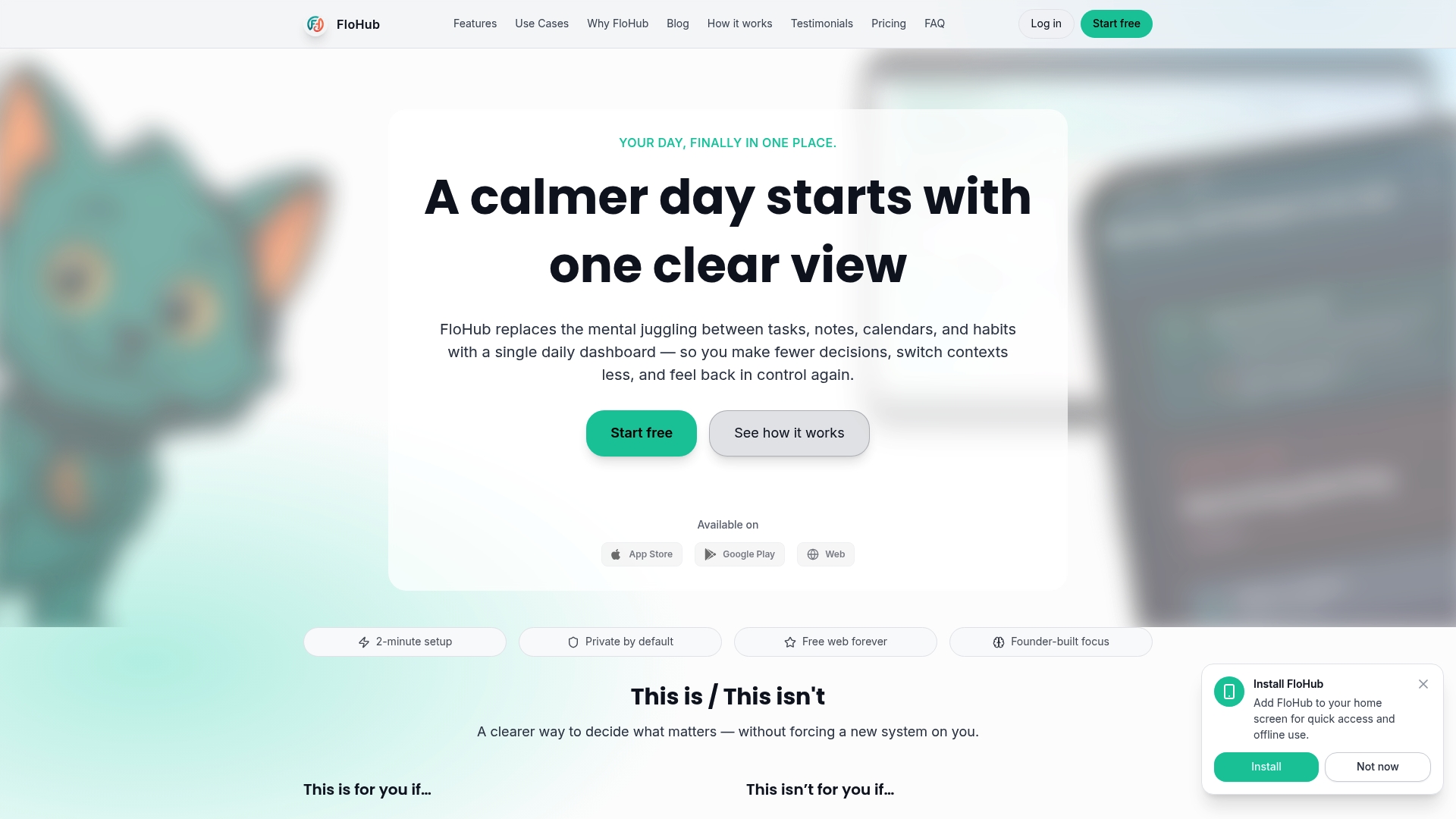
FloHub's user-friendly design supports essential productivity needs while maintaining the simplicity that makes routines sustainable. Whether you're a busy professional managing competing priorities or someone seeking better daily organization, FloHub for professionals offers practical solutions. Explore daily planning use cases to see how integrated goal tracking, calendar management, and task organization work together seamlessly. The web version remains free and fully functional, with optional mobile apps for on-the-go access. Discover how FloHub features can transform your productivity approach today.
What is a daily routine checklist and why use one?
A daily routine checklist is a structured list of prioritized tasks and habits designed to boost productivity and reduce decision fatigue. It provides a clear roadmap for your day, eliminating the mental energy wasted on figuring out what to do next. By managing time, energy, and focus systematically, you accomplish more while feeling less overwhelmed.
How does habit stacking improve my daily routine?
Habit stacking increases adherence by up to 91% by linking new behaviors to existing ones your brain already recognizes. This method leverages natural neural pathways, making new habits feel automatic rather than forced. After you complete an established routine like making coffee, you immediately tackle your new habit like reviewing priorities. The connection reduces the mental effort needed to remember and sustain new behaviors. Explore habit tracking tools to implement this powerful technique in your daily routine.
What are the pitfalls of relying too much on digital productivity apps?
Feature bloat in productivity apps leads to decreased usage and burnout as users become overwhelmed by complexity. Too many options create decision paralysis rather than clarity. Over-reliance on apps can also disconnect you from the intentional thinking that drives genuine productivity. The best approach balances digital tools with mindful planning, using technology to support rather than replace your judgment.
How often should I update my daily routine checklist?
Review your checklist monthly to ensure it aligns with current goals and circumstances. Weekly micro-adjustments handle immediate friction points, while quarterly deep reviews assess whether your routine still serves your bigger objectives. Life changes constantly, so your checklist should evolve with your priorities. Rigid adherence to outdated routines wastes energy on tasks that no longer matter.
Can a simple checklist really improve productivity significantly?
Research shows that structured checklists reduce decision fatigue and boost productivity by 10 to 30 percent through clearer prioritization. The key is matching checklist complexity to your actual needs rather than adopting someone else's system. Simple, personalized checklists outperform elaborate generic plans because they reduce friction and maintain long-term sustainability. Start minimal and expand only when core habits become automatic.